
Thoughts on: Birthdays, “Full of Themselves,” and the Kind of Confidence We Should Protect
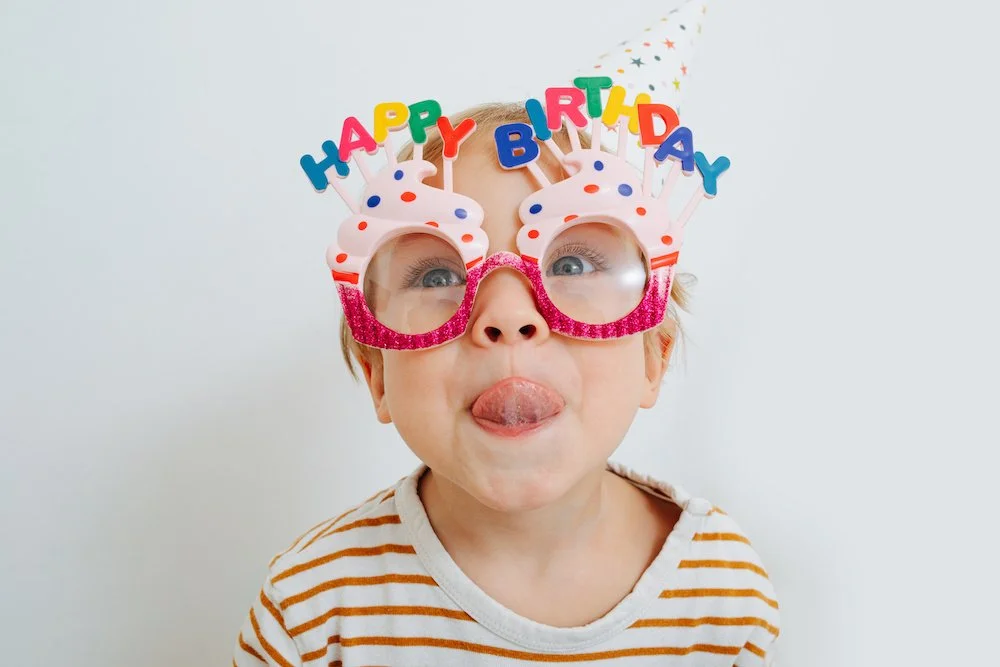
It’s my birth month, which means one thing in my house: I am spiritually required to have Thoughts. And I am spiritually obligated to Share. (You’re so welcome.)
First things first. I love my birthday. I love the clean, sparkling logic of it. A birthday is the one day a year that says, “It’s all about You. You’re allowed.”
It’s permission to celebrate being alive, to feel worthy of attention, to receive love without earning it first. I lean into it. Bigly.
I don’t think that makes me self-centered. I think it makes me… properly centered.
And that brings me to kids.
Kids arrive already knowing something many adults spend decades trying to reclaim:
I matter. I belong. I’m allowed to want things.
A baby doesn’t come into the world politely minimizing their needs. A toddler doesn’t ask permission to feel delighted by their own accomplishments. A preschooler doesn’t wonder if they’re “too much” when they tell you the same story for the ninth time and expect you to react like it’s opening night on Broadway.
They’re not being arrogant. They’re being whole.
But somewhere along the way, a lot of kids start getting feedback that their wholeness is a problem.
“Don’t be so dramatic.”
“Stop making it all about you.”
“You’re too sensitive.”
“You’re too loud.”
“You’re too much.”
Sometimes it’s said with irritation. Sometimes it’s said jokingly. Sometimes it’s said with love but without awareness. Either way, the message lands.
And here’s the part I want to say clearly at this moment: we’re living in a time when kids are getting “shrink” messages from every direction.
School pressure. Social media performance. Comparison culture. Adult stress spilling into family life. The constant push to be impressive, agreeable, efficient, “easy.”
So when a child shows up big, intense, expressive, or convinced of their own importance, it’s easy to label it as “full of themselves.”
But what if that phrase is pointing at the wrong problem?
What if “full of themselves” is actually a sign of health?
Let’s translate it into something more accurate:
“Full of themselves” = secure enough to be visible
“Full of themselves” = not ashamed of needing
“Full of themselves” = still connected to their own value
“Full of themselves” = not yet trained to disappear
Sometimes it’s messy. Definitely inconvenient at times. Sometimes your child’s confidence shows up as bossy, blunt, or socially clunky. Sometimes it looks like they genuinely cannot comprehend why the family can’t spend the next 45 minutes discussing the Minecraft dog they just tamed.
But developmentally, that self-centeredness is often part of the work. Kids start inside themselves. Over time, with safety and coaching, they learn how to hold both truths, which are 1) I matter and 2) Other people matter too.
You don’t teach empathy by crushing a child’s sense of self. You teach empathy by building a sturdy self and then expanding their awareness outward.
What I worry about isn’t kids who are too full of themselves.
I worry about kids who start to empty out early.
Kids who learn to scan the room before they speak.
Kids who apologize for existing.
Kids who stop asking for help because it feels like a burden.
Kids who become “so mature” (which often means: so practiced at hiding).
Kids who mask their own needs.
That’s survival, not humility.
And when we confuse survival for good behavior, we accidentally reward the very thing that makes adulthood so hard later: the habit of shrinking.
“But I don’t want to raise a narcissist.”
Good. Me neither.
The goal isn’t to raise kids who think they are the only important person in the room. The goal is to raise kids who know they’re important without needing to make anyone else smaller to prove it.
Healthy self-worth doesn’t create narcissism. It creates capacity.
A child who feels secure tends to have more room for:
repair after conflict
accountability without collapse
empathy without self-erasure
leadership without domination
And frankly, in a world that keeps throwing complex problems at the next generation, we need humans who can stand in their worth without being brittle, defensive, or performative about it.
So what do we do, practically?
Treat “look at me” as a connection bid, not a flaw.
When your child is showing off, interrupting, narrating their entire existence… they’re often saying: “Am I safe to be seen?” You can respond with a quick “I see you” without letting it take over the whole room.
Separate worth from behavior.
Yes, notice when they’re “being good”, and comment on it. Fine. But don’t forget to make space for just celebrating who they are when they’re not doing anything in particular. Tell them you love them for no reason. Give them a squeeze or a smile because they just are. (PS: that’s called Unconditional Love.)
Replace “You’re so full of yourself”.
Try:
“You feel proud of yourself right now.”
“You really want to be seen.”
“You’re having a big ‘I matter’ moment.”
Those lines keep the dignity intact while you coach the social skill.
Model, model, model.
This is where my birthday comes back in. Every year, I let myself receive some extra love and attention. Not because I’m special, but because I am a human upon the earth.
Kids watch that. They learn whether adults can be pleased with themselves without guilt. Whether joy is allowed. Whether worth has to be earned.
If you want your child to stay connected to their value, let them see you stay connected to yours.
A birthday wish, every year
Every year on my birthday, I return to this idea because it feels like a small act of resistance:
Let people be filled with themselves. Let them be Whole.
Kids are born whole. They arrive “full of themselves” in the best way.
Instead of draining that, can we help them carry it forward, refine it, pair it with empathy and create a world where people hold onto their worthiness?
I’m blowing my own mind right now, so I’ll stop there. I’d love to hear your thoughts, questions and “yeah, buts”.
xo G